The Night-Attendant Checklist at Lakeview 24-Hour Coin Wash
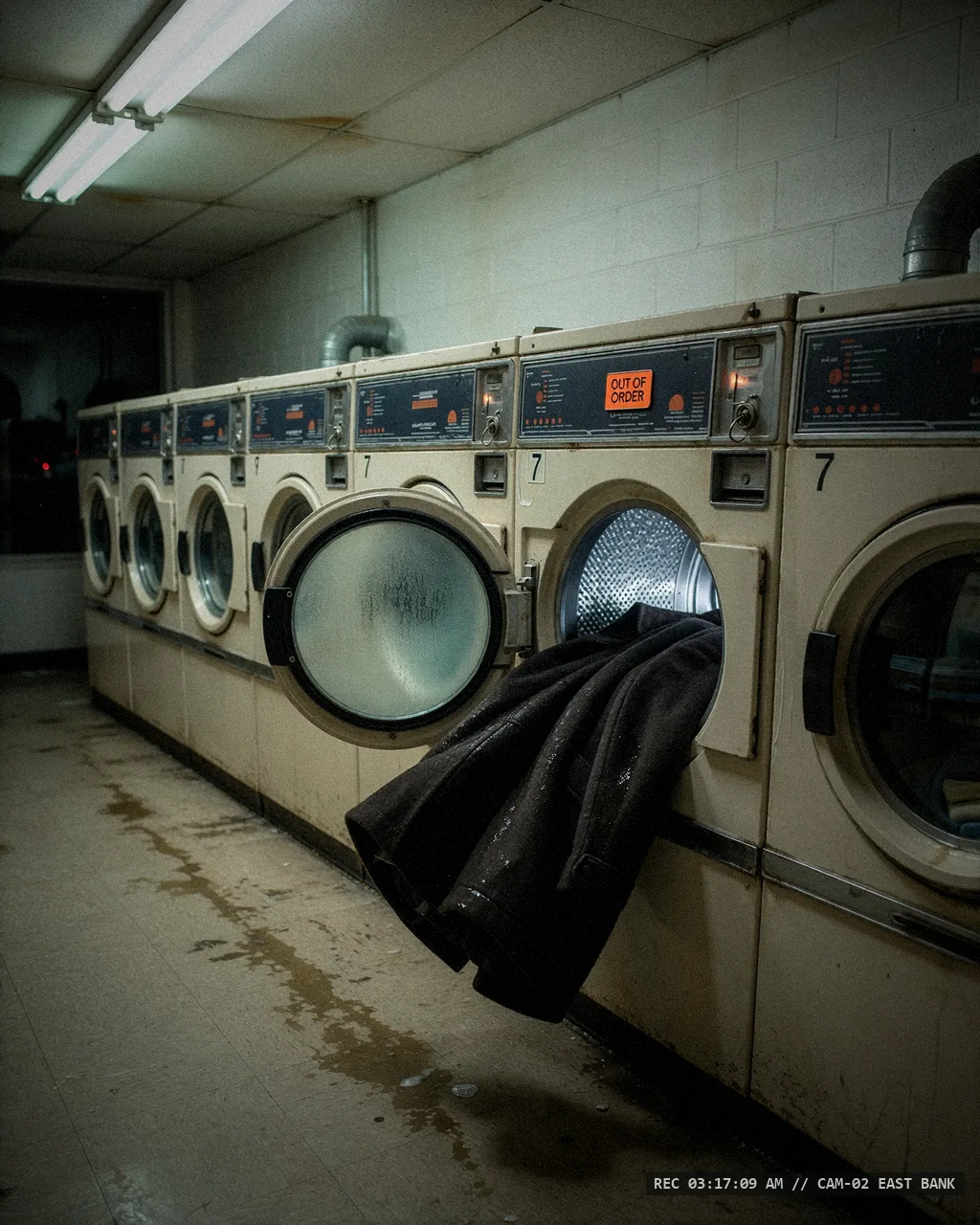
If you have ever worked third shift in a Lake Erie town after November first, you already know the kind of quiet I mean. Not peaceful quiet—just wet road slush tracked across beige linoleum, two buzzing fluorescent tubes out of twelve flickering pink at the ends, and Route 531 going forty minutes without a single pair of headlights passing the front plate glass.
I took the overnight attendant job at Lakeview 24-Hour Coin Wash for fourteen-fifty an hour off an index card pinned to the hardware store corkboard. Half my hours were supposed to be wiping detergent drips off the top-loaders, emptying lint traps, and keeping teenagers from sleeping in the rolling wire carts. The rest of the night, the owner said, I could sit behind the plywood counter with a paperback as long as the floor shone by six.
Mr. Kravitz interviewed me for maybe six minutes in his idling Ford Ranger outside the curb. He never even came inside. Through a cracked driver-side window smelling of wintergreen tobacco and wet wool, he handed me two brass keys on a hardware tag, explained how to unjam Canadian nickels from the Rowe bill changer using a flathead screwdriver, and pointed toward the rear utility door.
Right before he shifted out of park, he lowered the window another inch.
“Inside the gray steel cabinet behind the soap dispenser, there is a yellow laminated page,” he said, eyes fixed on his side mirror. “Don’t toss it with the trash. Read the five lines typed on the back. Follow them to the letter, especially between three and three-thirty. Pay goes out every Friday in an envelope under the register tray.”
Before I could ask whether that had something to do with the boiler pressure or local drifters, his taillights were already turning onto Lake Avenue.
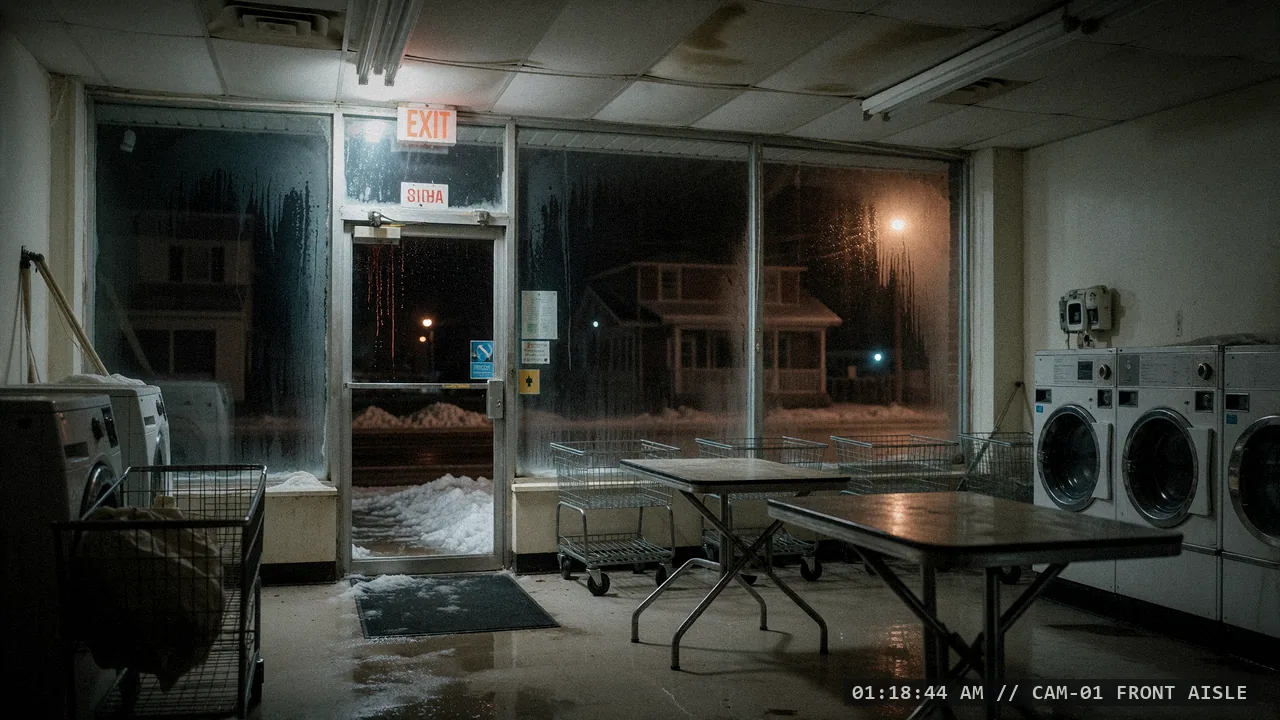 Exhibit 01: Interior aisle of Lakeview Coin Wash photographed from the folding counter facing the street windows at 01:18 AM.
11:45 PM — The Binder Under the Change Machine
My first two nights were uneventful enough to make me feel guilty for taking the wage. One retired tugboat mechanic came in around midnight on Tuesday to wash heavy canvas coveralls, nodded once, and read an old Field & Stream until his spin cycle ended. After 12:40 AM, the place belonged entirely to me and the low hum of the vending cooler.
On Thursday—November fourteenth, when the first lake-effect squall started throwing sleet sideways against the front sign—nobody came in at all. Around a quarter to twelve, after mopping the salt crust from the entrance mat toward the rear floor grate, I unlocked the dented supply locker behind the Tide vending rack to grab fresh trash liners.
Taped at eye level inside the locker door was the sheet Mr. Kravitz had mentioned.
It wasn’t a standard OSHA notice or a plumbing diagram. It was a heavy legal-sized page sealed inside thick, yellowed lamination that had begun peeling at the bottom corners. Someone had typed it years ago on a manual ribbon typewriter where every lowercase e sat slightly above the line:
NIGHT CUSTODIAN — OVERNIGHT OPERATING NOTES (11 PM – 6 AM)
- Mop from the street entrance toward the rear floor drain. Never push standing water from the back wall toward the front sidewalk.
- Keep the Panasonic AM radio under the counter plugged in and tuned to 1490 kHz. After midnight there is no broadcast, only carrier hiss. Do not switch it off and do not tune it to music.
- Commercial Dryer #7 on the east bank has carried an OUT OF ORDER magnet across the coin slide since 2019. Keep that magnet centered over the slots. If a customer asks to use #7 because the other dryers are full, refund their wash out of petty cash and send them home.
- If Dryer #7 begins turning on its own after 3:00 AM, do NOT go behind the service bulkhead to check the breaker, and do NOT lean closer than four feet to peer through the round glass door. Reach out from an angle and touch the outer rim of the glass briefly with the back of your wrist.
- If the glass feels hot, turn around calmly, step into the office, and count sixty seconds until the cycle buzzer clicks once. If the drum is tumbling and the glass feels ice-cold, immediately dump the blue plastic cup of quarters sitting atop Machine #8 straight down the center floor drain, step into the office, slide the deadbolt, and do not look at the security monitor until 3:45 AM.
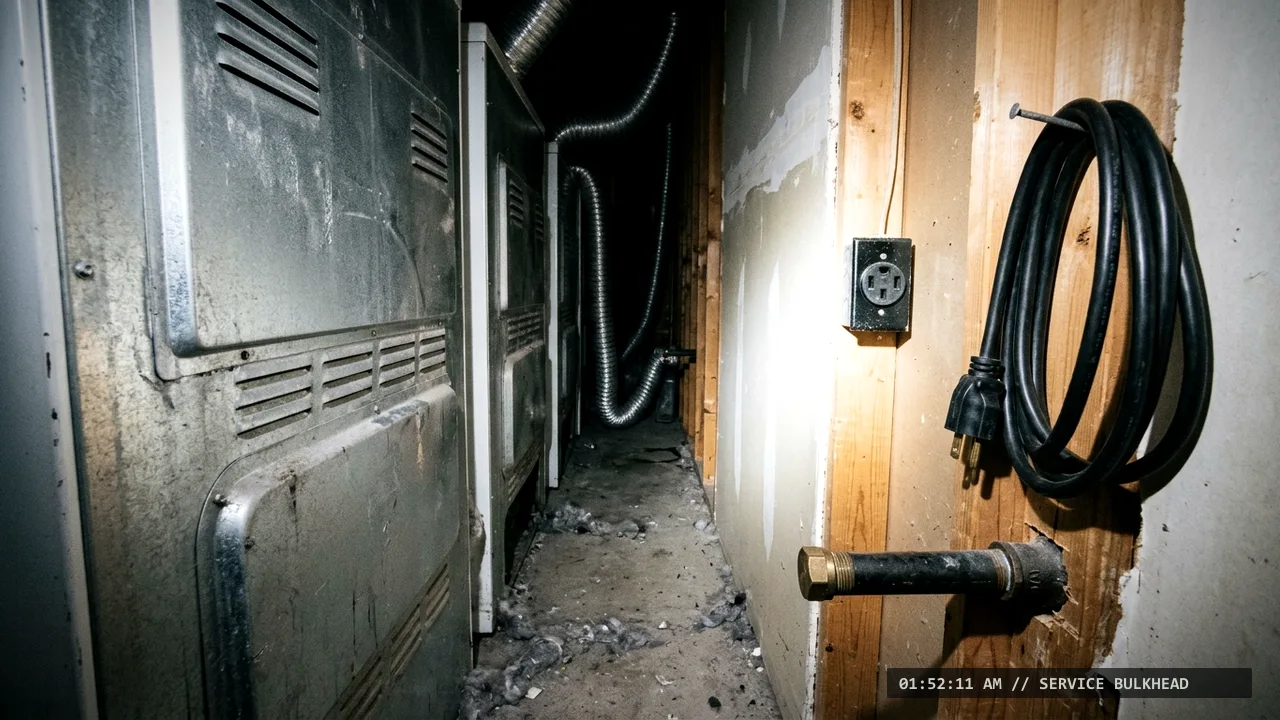 Exhibit 02: Cellphone flashlight photograph taken behind the east service bulkhead at 01:52 AM showing unit #7’s disconnected power cord coiled on a wall stud.
I stood there with a roll of clear 55-gallon drum liners under my arm and grinned. Every slow third-shift workplace has folklore invented by bored attendants trying to scare the next hire into quitting—or at least keeping them awake past two in the morning.
Still, curiosity made me walk down the east bank of Huebsch thirty-pound dryers.
Units one through ten lined the cinderblock wall in a row of scratched almond enamel. Every porthole reflected the green exit sign except #7, whose round glass window looked faintly clouded on the inside, as if someone had wiped it years ago with a soapy rag and never rinsed it clean. Centered neatly across its four quarter slots sat a cracked orange magnet reading OUT OF ORDER — DO NOT USE.
And up on the sheet-metal top of Dryer #8, tucked behind the exhaust riser where a short customer wouldn’t notice it, sat a faded blue Solo cup half-filled with tarnished quarters. Every coin in the cup was dull gray and sticky with old lint, none of them stamped later than the eighties.
01:50 AM — Checking the Service Bulkhead
Around ten to two, boredom got the better of me. The narrow maintenance alley behind the dryer bank wasn’t locked—just held shut with a brass hook-and-eye latch to keep customers out of the lint ducts. I clicked on my phone light and ducked behind the drywall partition.
It smelled of warm dust, scorched fabric softener, and dry mouse droppings. Dryers #1 through #6 and #8 through #10 all had thick black 240-volt pigtails plugged into wall boxes, along with corrugated aluminum exhaust ducts running into the main ceiling trunk and yellow flexible gas lines connected to brass shutoff valves.
When I swung my beam onto the back of #7, my smile faded a little.
Dryer #7 wasn’t broken in the usual sense. Its heavy three-prong power cord was unplugged completely, coiled neatly on a roofing nail driven into the stud. Its gas valve had been removed and sealed at the iron pipe with a threaded hex cap coated in dried pipe dope. Even the six-inch exhaust collar at the bottom rear of the cabinet had been riveted shut with a square patch of galvanized sheet metal.
There was no power, no gas, and no airflow connected to that machine. Mechanically, the steel drum inside couldn’t turn unless somebody climbed inside and spun it by hand.
I backed out of the service alley, latched the hook, and decided Mr. Kravitz was simply an eccentric seventy-year-old landlord who believed whatever superstitious nonsense his nephew had typed up five winters ago. I sat behind the plywood counter, listened to the steady, gentle white hiss of 1490 AM on the little plastic radio, and read eighty pages of an old paperback while sleet ticked against the storefront letters.
03:11 AM — Cycle Seven
I didn’t fall asleep. I know that for a fact because at 3:09 AM I got up to stretch my calves and drop a tea bag into my thermos cup from the hot-water tap by the utility sink.
At 3:11 AM, the carrier static coming from the Panasonic radio stopped.
It didn’t fade out or crackle. One second the speaker was breathing steady gray noise into the room; the next second the red power LED stayed lit while the speaker went completely dead, as if someone at the transmitter tower had pulled a knife switch.
Three seconds later, down at the far end of the east aisle, a relay clicked inside enameled steel.
Then came a low, rhythmic whump… whump… whump—the unmistakable heavy thud of wet, soaked winter fabric lifting to the top of a steel drum and slapping back down against the baffles.
I stood beside the folding tables with my thermos lid unscrewed in my hand. Every hair on my forearms stood straight up under my flannel shirt. Down the row, the little amber “HEATING” indicator lamp above Dryer #7—the machine whose power cord I had seen hanging unplugged on a nail eighty minutes earlier—was glowing a dim, steady orange.
Through the clouded round glass, something dark and heavy rolled over and over in slow revolutions. Not fast like a normal spin cycle, and without the roar of a blower fan. Just the slow creak of rollers and the wet, sodden slap of heavy cloth—almost like a soaked wool coat weighed down with lake water—accompanied by the faint metallic clink of a brass zipper or buckle striking the perforated drum once every turn.
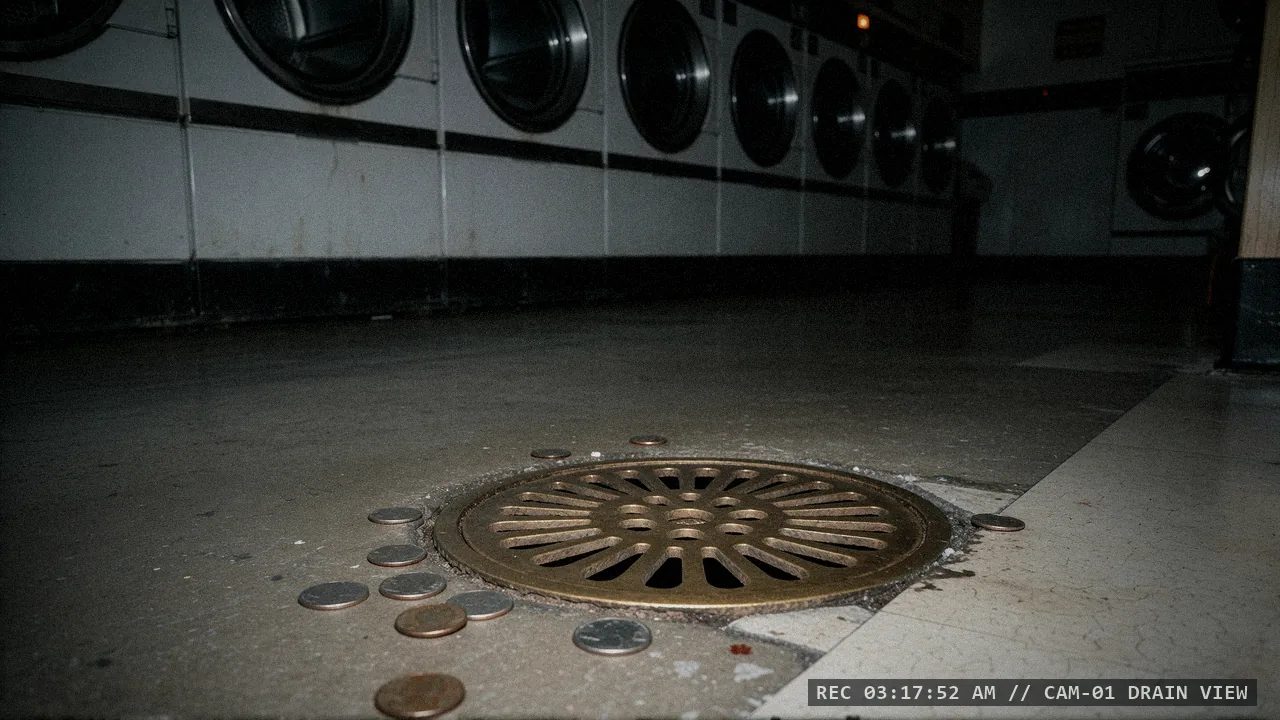 Exhibit 03: Secondary still exported from four-channel DVR (CAM-01 aisle angle) at 03:17 AM. Note illuminated indicator lamp above unit #7.
Every instinct in a rational brain tells you to walk over, crouch down, and see what is actually inside the drum—whether a raccoon somehow squeezed through a roof vent or a neighbor rigged a prank timer. My feet carried me halfway down the rubber floor runner before Line 4 from that yellowed sheet flashed behind my eyes:
Do NOT lean closer than four feet to peer through the round glass door. Reach out from an angle and touch the outer rim of the glass briefly with the back of your wrist.
I stopped beside Dryer #8, keeping my shoulders angled away from the porthole of #7 so I could only see the turning dark mass in my peripheral vision. Even from three feet to the side, I smelled it seeping around the rubber door gasket—not detergent or scorched lint, but raw, freezing November lake silt and wet cellar concrete.
Holding my breath, I extended my left arm sideways and brushed the back of my wrist against the bevel of #7’s glass window.
It wasn’t warm. It wasn’t even room temperature. A thin rime of condensation froze under my skin on contact, colder than the sleet-covered storefront glass facing the highway.
Inside the drum, the tumbling abruptly stopped mid-rotation.
In the reflection of Dryer #6 across the narrow folding table, I caught a fraction of a second of the clouded glass on #7 clearing from the center outward—as if something pressed close to the inside of the porthole had just exhaled—Wait, no: glass fogs when breath is warm. The frost was forming from the inside out, and behind that circular pane, two pale, water-wrinkled knuckles tapped once, very politely, against the latch side of the door.
03:18 AM — The Floor Drain
I didn’t think. I snatched the faded blue plastic cup off the top of Machine #8 so hard two quarters bounced across the linoleum. Six strides brought me to the brass grate set into the center of the concrete floor between the triple-load washers.
I upturned the cup. Thirty or forty lint-caked quarters rattled through the wide slots of the iron grate and splashed into the dark trap pipe below.
Except they didn’t hit three inches of standing U-bend water the way coins should. I heard them fall—clinking against wet brick—for nearly two full seconds before a distant, hollow splash echoed up through the drainpipe.
Behind me on the east wall, the stainless-steel door latch on Dryer #7 gave a sharp, dry snap, the sound a Huebsch door makes when somebody pushes it open from the inside by a quarter inch.
I didn’t turn around to look. I sprinted the remaining fifteen feet into the cramped plywood office behind the change machine, slammed the hollow-core door—thankful someone had replaced it years ago with a solid steel exterior slab—and threw the heavy brass deadbolt.
On the desk sat the black four-split CCTV monitor. Rule 5 said do not look at the security monitor until 3:45 AM. Without looking at the screen, I reached sideways, hooked my fingers under the plastic bezel, and tilted the monitor face-down onto the blotter pad.
For twenty-six minutes I sat on an overturned bucket with my knees pulled against my chest, staring at my wristwatch.
At 3:22 AM, slow, deliberate footsteps crossed the linoleum outside the office wall. Whatever walked down the center aisle was wearing boots heavy enough to squeak slightly on the damp floor—stop-and-go, pausing right over the center floor drain for almost five minutes. I heard the iron grate scrape aside an inch, followed by a long, patient metallic clinking, one coin at a time, as if someone were fishing quarters out of the dark below.
At 3:39 AM, the footsteps moved back toward the east wall. The heavy dryer door clicked shut. A single mechanical cycle buzzer—one flat, rusted bzzzzzt—sounded through the empty laundromat.
At 3:41 AM, the Panasonic radio on the counter outside burst back to life with loud, reassuring midnight static.
04:20 AM — Filing & Departure
I stayed locked in that room until 4:15 AM. When I finally unbolted the steel slab and stepped out under the humming fluorescents, the laundromat was completely empty.
Dryer #7 was dark. The orange OUT OF ORDER magnet was still centered neatly over the coin slide. Along the floor between the east wall and the center drain, there wasn’t a puddle or a muddy boot print—just four damp, circular impressions the size of a coffee mug leading from #7 to the brass grate, already evaporating in the dry radiator heat.
And up on top of Machine #8 sat the faded blue plastic cup, upright and empty, waiting to be refilled from the change machine before the next shift.
I finished mopping from the street windows toward the back drain, locked up at 6:00 AM, and left the two brass keys inside an envelope under the register tray alongside a note telling Mr. Kravitz to mail my one night’s pay—or keep it toward the next cup of quarters. When I drove past Lakeview Coin Wash two mornings later in broad daylight, a fresh 3-by-5 index card was already taped inside the front glass: NIGHT ATTENDANT WANTED — 11 PM TO 6 AM — CASH PAID FRIDAYS.
Keep the Archive Independent & Access Unredacted Notes
To comply with public ad-network guidelines, portions of the recovery log and high-resolution uncropped evidence plates are stored offline. Reader contributions directly fund server hosting and new case restorations.
Archivist’s Filing Note // CASE-001
Filed under Division [SR] Shift & Rules. Cross-referencing municipal utility work orders indicates commercial gas service to bay #7 was permanently capped in March 2018 following an unreported after-hours service call. Current whereabouts of proprietor M. Kravitz remain unverified.